Most crowd problems at events are predictable. Queues back up onto a road because there are too few gates. People bunch in front of a bar that sits next to the main walkway. Everyone leaves at once through the same exit they came in by. Good crowd management is mostly about spotting those problems on paper, long before the gates open.
This guide walks through the four stages of a crowd’s journey and what organisers need to plan at each one.
Who is responsible?
The event organiser has the main duty to plan for crowd safety, as part of their wider health and safety and fire safety duties. That responsibility sits in your event risk assessment and your event management plan. HSE’s event safety pages set out organisers’ responsibilities, and for open-air events the government’s fire safety risk assessment guide for open-air events covers escape routes and exit capacity in detail.
Larger events may also need specialist crowd safety advice, licensed security staff and input from the local Safety Advisory Group. Whatever the size, the plan needs to be realistic about the number of people and how they will behave.
The four stages of crowd flow
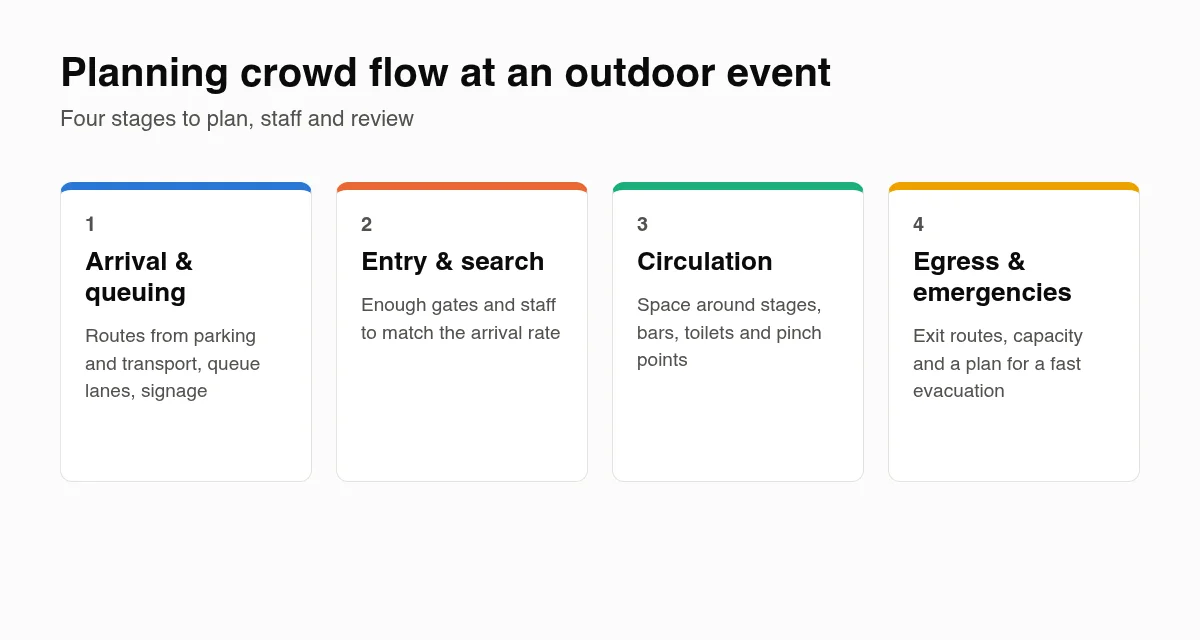
1. Arrival and queuing
- Work out how people will arrive: car parks, shuttle buses, trains, on foot. Each creates a different arrival pattern.
- Estimate the peak arrival rate, not just the total. A crowd that arrives in the hour before a headliner needs far more gate capacity than one arriving across a whole day.
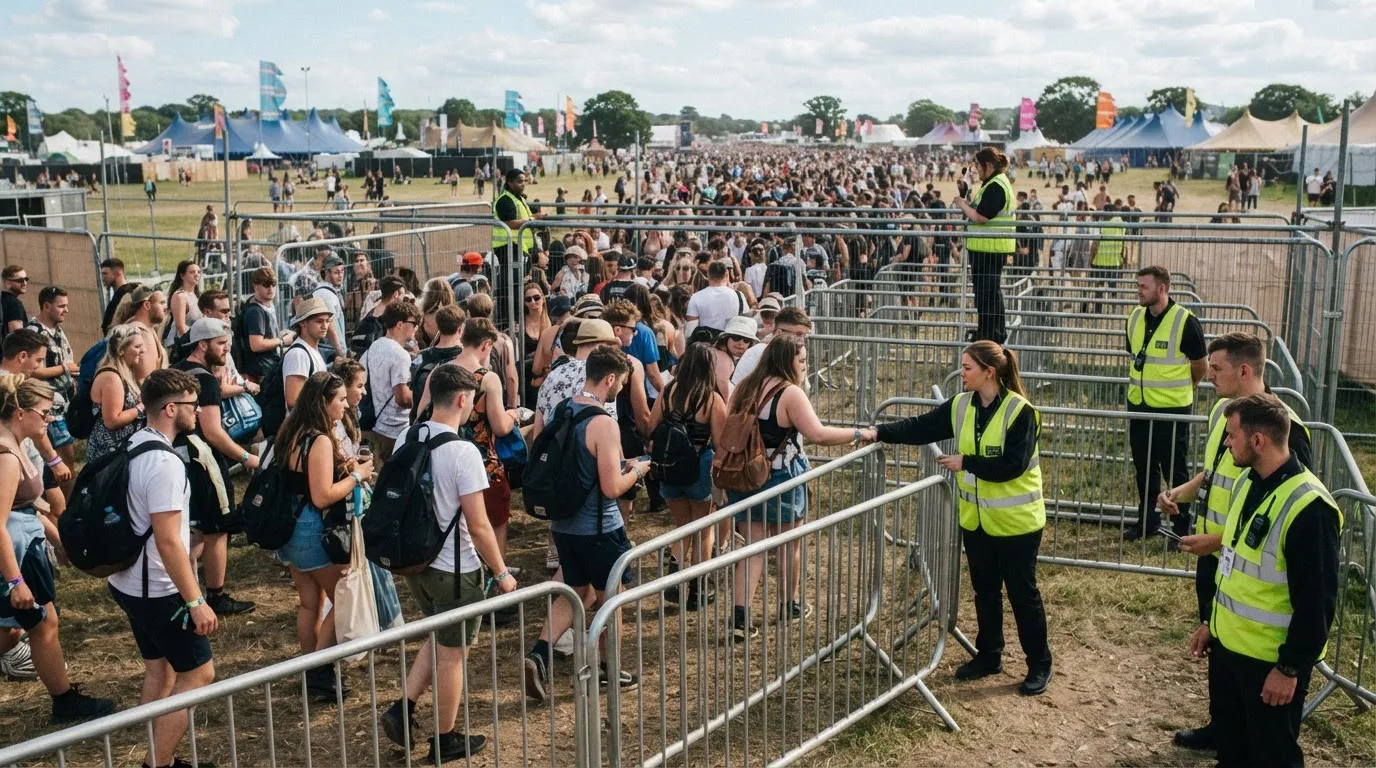
- Keep queues off roads and away from vehicle routes. Use barriers to form lanes and give people somewhere sensible to wait.
- Signage and stewards along approach routes help people find the right gate first time.
2. Entry and search
- Match the number of gates and staff to your arrival rate. If each search and ticket scan takes time, the queue grows quickly when people arrive faster than you can process them.
- Separate entry and exit flows where you can, so people leaving early do not push against those coming in.
- Have a plan for opening extra lanes, or delaying a show start, if queues build.
3. Circulation inside the site
- Look for pinch points on your site plan: narrow walkways, gateways between fields, bars and food stalls that sit on main routes.
- Leave space for queues at bars, toilets and food stalls so they do not block walkways.
- Think about the stage front: barriers, a pit for stewards and first aid access, and how the crowd will move between stages at changeover times.
- Weather changes behaviour. Rain sends everyone under cover at once, and heat drives people to water points. Our guide to planning for bad weather covers the triggers to plan for.
4. Egress and emergencies
- The end of the event is often the busiest moment. Plan how people will leave, including lighting routes after dark and managing traffic in car parks.
- Emergency exits must be wide enough for the crowd and kept clear. The fire safety guide explains how to work out exit capacity.
- Agree how an evacuation or show stop will be announced, who makes the call, and where people should go.
Common crowd problems and what helps
| Problem | What helps |
|---|---|
| Long queues at opening | More gates, earlier opening, staggered arrival times on tickets |
| Bunching at bars and food stalls | Move them off main routes and leave space for queues |
| Crowd surges at the stage front | Front-of-stage barrier, trained stewards, clear show-stop procedure |
| Everyone leaving at once | Several exits, lit routes, stewards at junctions, staggered closing of areas |
| Blocked emergency routes | Regular checks, clear signage, nothing stored on routes |
The role of stewards and crew
Stewards are the eyes and ears of the crowd plan. They need to know the site, the exits, how to report a problem and what to do if the show is stopped. That starts with a good crew briefing and site induction. Where security work requires a licence, such as door supervision, make sure those staff hold the correct SIA licence.
Production crew matter too. Barriers, fencing, signage and lighting towers all have to be built on time and in the right place for the crowd plan to work. A late build that leaves a gateway half-finished or an exit route unlit undoes the planning.
Get the crew to build it right
Idloes Stage Crew provides experienced event crew across Mid Wales and the borders to build barriers, fencing, staging and site infrastructure safely and on schedule. See our services or book crew for your event.