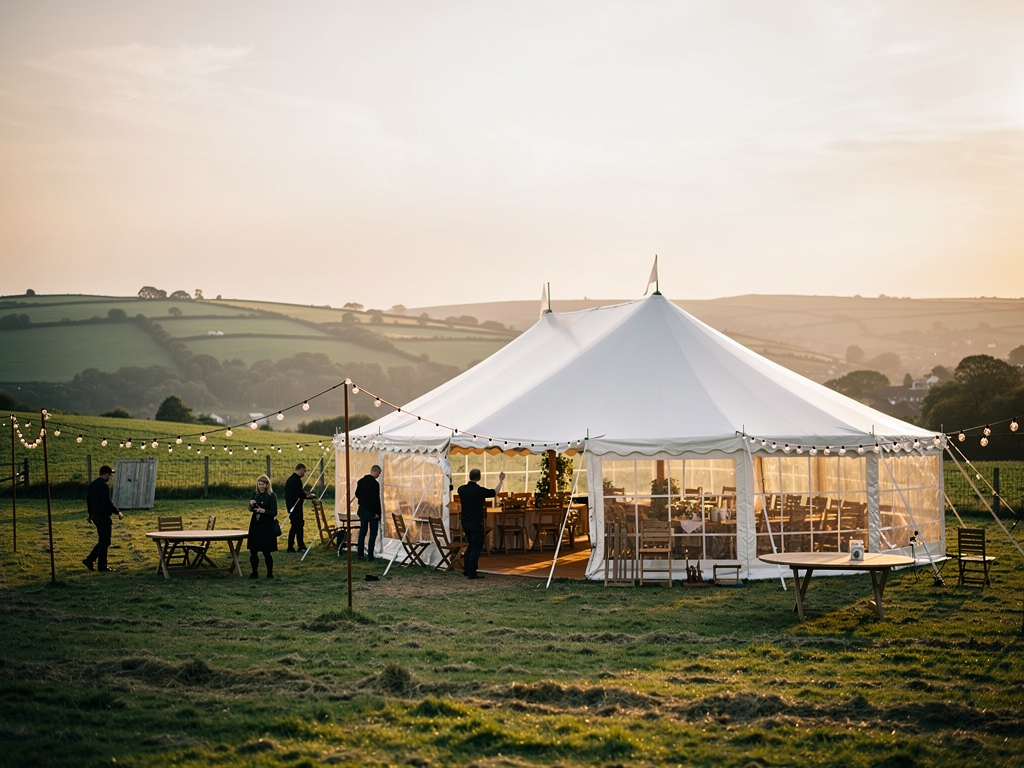
A marquee on a family farm, with the hills of Mid Wales behind it, makes a beautiful setting for a wedding. It also means you are building a temporary venue from scratch in a field. This checklist covers the things couples and their families most often need to think about, from the legal side to getting a lorry through the gate.
1. Understand the legal ceremony rules
This is the point that surprises most couples. In England and Wales, a civil wedding must take place at a register office or at approved premises, such as a licensed hotel or wedding venue. Since April 2022, civil ceremonies can be held outdoors, but only within the grounds of approved premises. A private field or family garden is not normally approved premises.
Humanist and other celebrant-led ceremonies are not currently legally binding in England and Wales either. The government consulted on reforming weddings law in summer 2026, but at the time of writing the law has not changed.
So many couples who want a marquee or farm wedding hold a short legal ceremony at the register office, then have a celebrant-led ceremony on the day in the marquee or field. Contact the registration service for the area early to book the legal part.
2. Check whether you need a licence for the bar
If guests will pay for drinks, or if alcohol is being sold in any way, you will usually need a Temporary Event Notice (TEN). In Powys, TENs are given through the council’s online form, cost £21 and must be given at least 10 working days before the event. A free bar for invited guests is not usually a licensable activity, but if you are unsure, ask the council’s licensing team. Our guide explains how Temporary Event Notices work, and our guide to licences and who to tell in Mid Wales has the council contacts.
3. Choose the right spot in the field
- Level, well-drained ground. Avoid hollows where water collects and steep slopes. Your marquee supplier will advise on how much slope they can work with.
- Shelter from the wind. A spot sheltered by trees or a hedge is more comfortable, but keep clear of overhanging branches.
- Buried services. Ask the farmer about field drains, water pipes and cables before any pegs or stakes go in.
- Distance from neighbours. Music carries a long way across quiet valleys. Think about where the speakers will face and when the music will stop.
- Livestock. Agree with the landowner when the field will be cleared of animals and how gates will be managed during the event.
4. Plan access for suppliers and guests
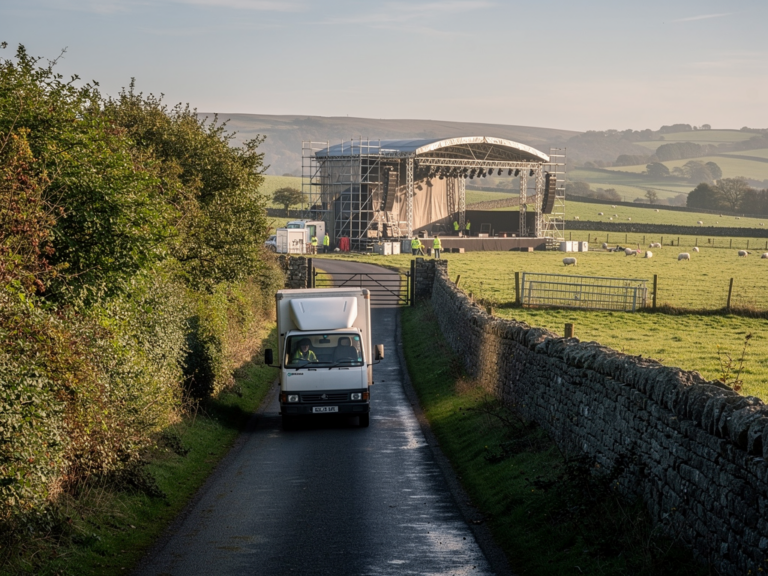
A marquee, its flooring and furniture often arrive on a large lorry. Check the lane, gate width, turning space and ground before you confirm suppliers. For guests, plan parking on firm ground near the entrance, with someone to direct cars and a wet-weather plan, such as a tractor on standby. If guests will walk from the car park in the dark, light the route. Our guide to rural event logistics in Mid Wales goes into more detail on access, mobile signal and travel.
5. Power, toilets, water and lighting
- Power. Most fields have no mains power, so you will need a generator big enough for the caterers, the band or DJ, lighting and any heating. Keep it away from the marquee and protect cable runs. See our guide to temporary power at outdoor events.
- Toilets. Hire enough for your guest numbers and place them on firm, lit ground within easy reach of the marquee.
- Water. Caterers will need clean water. Check what is available on the farm and whether it is safe to drink.
- Lighting. Festoon lighting inside, plus practical lighting for paths, toilets, the bar and car park.
6. Plan for Welsh weather
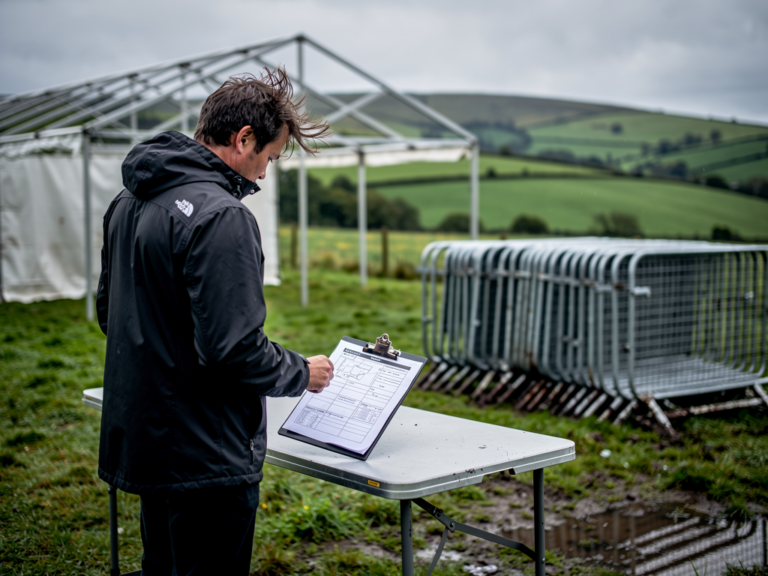
Even in midsummer, Mid Wales can bring strong winds and heavy rain. Ask your marquee supplier what their wind speed limit is and who decides if guests need to leave the marquee. Have side walls ready to go up, matting for wet entrances and a plan for a hot, still day too. Our guide to planning for bad weather at outdoor events has more detail.
7. Build a realistic set-up timeline
A marquee wedding usually takes several days of work. A typical plan looks like this, although your suppliers will set the exact timings:
| When | What happens |
|---|---|
| 2 to 3 days before | Marquee and flooring built. Generator and toilets delivered. |
| The day before | Tables, chairs, dance floor and bar set up. Lighting and decorations installed. Caterers’ area prepared. |
| Wedding day | Final dressing in the morning. Suppliers and crew on hand for any changes. |
| The day after | Furniture, decorations, lighting and bar cleared. Rubbish removed. |
| 1 to 2 days after | Marquee, flooring, generator and toilets collected. Field checked and handed back. |
8. Get enough hands for set-up and clear-down
Friends and family will often offer to help, and that is lovely, but set-up and clear-down are long days of lifting and carrying, often after a late night. Professional crew can lay out furniture, put up lighting, set the bar and dance floor, and clear everything the next morning, so your family can enjoy the day. Our guide on what event crew costs in Mid Wales includes a worked example for a marquee wedding.
Wedding crew across Mid Wales
We provide wedding crew for marquee, farm and barn weddings across the region, including Llanidloes, Newtown, Montgomery, Berriew, Welshpool, Machynlleth, Aberystwyth, Builth Wells, Brecon, Hay-on-Wye and Crickhowell. Find out more about our wedding crew hire, or get a quote for your day.